Phonetically Balanced Sentences: Meaning, Examples, PDF, and Uses
Published June 24, 2026 · Updated June 24, 2026 · 14 min read
If you need a clean speech sample, random phrases are rarely good enough. A phrase like "testing one two three" checks whether a microphone is on, but it does not tell you much about plosives, fricatives, vowels, nasals, rhythm, or how speech sounds behave inside real sentences.
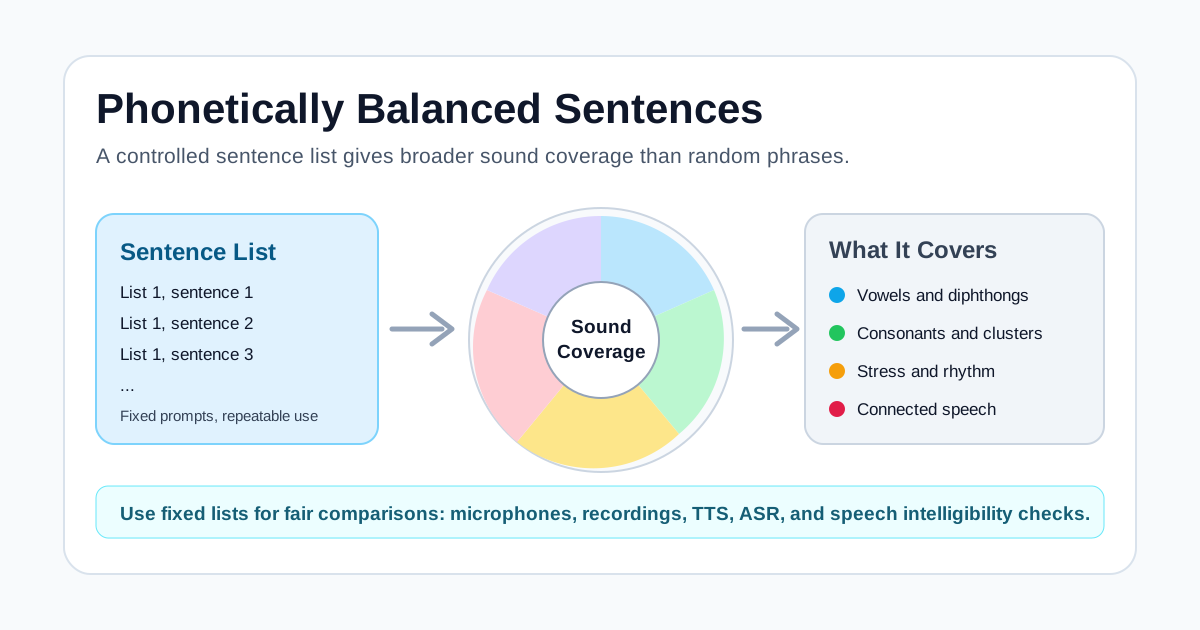
That is where phonetically balanced sentences help. They are sentence lists chosen so the sounds in the list represent the sound pattern of a target language more fairly than a handful of casual phrases.
For practical English examples, use the Interactive Harvard Sentences Tool. It includes all 720 Harvard Sentences, list filtering, random sentence generation, IPA, text-to-speech playback, PDF export, and CSV download.
What Are Phonetically Balanced Sentences?
Phonetically balanced sentences are sentences selected so that a list of them contains a representative mix of speech sounds. In English, that usually means the list should include a useful spread of vowels, consonants, blends, word endings, stress patterns, and connected speech.
The goal is not to create beautiful writing. The goal is to create speech material that is useful for testing, recording, listening, or comparing speech.
A normal sentence list might accidentally include too many easy sounds and too few difficult ones. A balanced sentence list tries to avoid that problem. It gives you a more reliable sample of how a speaker, microphone, audio system, or speech model handles the language.
In simple terms:
- A random sentence list is convenient.
- A scripted sentence list is controlled.
- A phonetically balanced sentence list is controlled for sound coverage.
This is why phonetically balanced sentences are common in speech intelligibility testing, audio engineering, audiology, speech technology, and linguistics.
Phonetic Balance vs Phonemic Balance
People often use "phonetically balanced" and "phonemically balanced" loosely. They are related, but not exactly the same.
The distinctions are easiest to think about by use case:
- Phonetic balance means the list covers speech sounds and sound patterns in a useful distribution. This is the practical concern in speech recording prompts, intelligibility checks, and audio tests.
- Phonemic balance focuses on phonemes, the contrastive sound units of a language. This matters more in linguistics, speech datasets, and pronunciation coverage.
- Lexical balance focuses on word choice, frequency, or familiarity. This is useful for reading tests, language learning, and controlled text.
- Sentence balance focuses on whole sentences, so each list behaves similarly in difficulty and sound coverage. Harvard/IEEE sentence lists and speech-in-noise materials are good examples.
For most practical users, the important question is not the label. The important question is whether the sentence list is suitable for the task you are running.
Why Not Just Use Random Sentences?
Random sentences can work for a casual voice sample, but they are weak for repeatable testing. The same speaker may sound very different depending on which random phrases you choose.
Suppose one script has many words like "moon," "name," and "now," while another script has many words like "six," "judge," and "church." The first script may be easier to record cleanly. The second script may expose more sibilants, affricates, and consonant clusters. If you compare results across those scripts, you may be measuring the script rather than the speaker or system.
Balanced sentences reduce that risk. They help you compare:
- One microphone against another.
- One room setup against another.
- One text-to-speech voice against another.
- One speech recognition model against another.
- One hearing or listening condition against another.
- One speaker's pronunciation across repeated recording sessions.
The result is not perfect scientific control, but it is much better than improvising a few phrases on the spot.
Harvard Sentences as a Practical Example
The best-known English example is the Harvard Sentences corpus, also called the Harvard lines or IEEE sentences. The standard set contains 720 phonetically balanced sentences, arranged as 72 lists of 10 sentences.
The public Harvard list hosted by Columbia University identifies the corpus as the "1965 Revised List of Phonetically Balanced Sentences" from IEEE speech quality measurement material. The format is useful because each numbered list is compact enough for a short session, while the full corpus gives broad coverage for larger work.
Examples include:
- "The birch canoe slid on the smooth planks."
- "Glue the sheet to the dark blue background."
- "The boy was there when the sun rose."
- "A pot of tea helps to pass the evening."
For the complete list, see:
- Harvard Sentences Tool - browse, filter, play, copy, export PDF, and export CSV.
- Harvard Sentences Complete Guide - background, structure, examples, use cases, and workflow.
What Makes a Sentence List Useful?
A useful phonetically balanced list usually has four qualities.
1. Sound Coverage
The list should include a broad spread of the target language's sounds. In English, this means it should not avoid common consonants, vowels, word endings, and clusters.
For microphone testing, this matters because different sounds stress the audio chain differently:
- Plosives like "p," "b," "t," and "k" can reveal popping and low-frequency bursts.
- Fricatives like "s," "sh," "f," and "v" can reveal harshness or noise reduction artifacts.
- Nasals like "m," "n," and "ng" can reveal resonance and muffled tone.
- Vowels can reveal coloration, room boom, and pitch clarity.
- Consonant clusters can reveal whether speech stays clear during fast transitions.
2. List Consistency
If you use several lists, the lists should be similar enough that one list is not obviously easier or harder than another. This is why established corpora are often split into numbered lists rather than one long block of text.
For example, one Harvard list has 10 sentences. That makes it convenient to assign:
- List 1 to microphone A.
- List 2 to microphone B.
- List 3 to a processed audio version.
- List 4 to a noisy playback condition.
You can rotate lists without asking the speaker to read the exact same text every time.
3. Natural Sentence Rhythm
Word lists are useful for some tests, but sentences are closer to real speech. Sentences include rhythm, context, pauses, reductions, and transitions between words.
This matters for:
- Text-to-speech evaluation.
- Speech recognition testing.
- Voice recording datasets.
- Pronunciation practice.
- Speech intelligibility work.
- Audio codec and noise suppression checks.
A system can handle isolated words well but still struggle with connected speech.
4. Practical Length
A sentence list should be long enough to cover useful sounds but short enough to finish consistently. If a script is too long, speakers become tired and recordings become inconsistent.
For quick work, one list of 10 Harvard Sentences is usually enough. For broader evaluation, use several lists and keep metadata about which list was used in each condition.
Common Use Cases
Voice Recording Prompts
Phonetically balanced sentences are useful when you need a speaker to record a structured voice sample. They provide a better spread of English sounds than casual prompts.
Use them when recording:
- Demo voice samples.
- Pronunciation samples.
- Speaker comparison clips.
- Training material for internal experiments.
- Dataset prompts for speech technology work.
For any voice dataset or voice model workflow, record only your own voice or voices you have clear permission to use.
Microphone and Audio Tests
For a microphone check, balanced sentences are more informative than "testing one two three." They let you hear how the microphone handles breath, plosives, sibilance, vowels, and word transitions.
A simple microphone test workflow:
- Pick one fixed Harvard list.
- Record the full list with microphone A.
- Record the same list with microphone B, or use another list if you want to avoid memorization.
- Keep distance, gain, room, and speaking style consistent.
- Compare clarity, noise, harshness, popping, and room tone.
If you are testing a noise suppression feature, record the same list in quiet and in controlled background noise. Do not change multiple variables at once.
Speech Intelligibility Testing
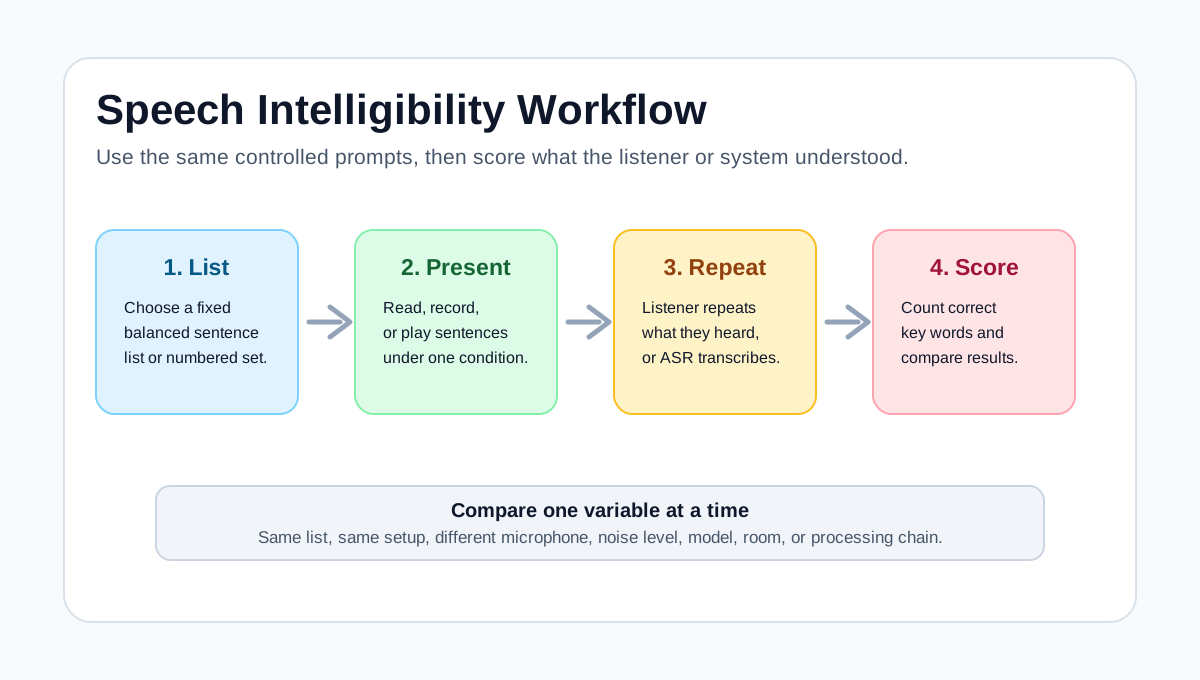
In speech intelligibility work, the listener hears the sentence and repeats what they understood. The tester then scores correct words, often focusing on key words rather than every word in the sentence.
The exact scoring method depends on the protocol. Some speech-in-noise tests use fixed sentence lists with five scored key words per sentence. QuickSIN, for example, presents six sentences in multitalker babble and scores how many key words the listener identifies correctly.
If you are not running a clinical test, you can still borrow the basic idea:
- Use a fixed sentence list.
- Play or read each sentence.
- Ask the listener to repeat it.
- Count key word matches.
- Compare scores across conditions.
Do not present casual practice results as a medical diagnosis. Clinical speech tests should be handled by qualified professionals using the correct materials, calibration, and procedures.
Text-to-Speech Evaluation
For TTS, phonetically balanced sentences help reveal whether a voice handles different sounds naturally. A short marketing paragraph may sound good because it avoids hard cases. A balanced list gives the system more chances to expose weak pronunciation, unnatural rhythm, or poor prosody.
Useful checks:
- Are consonants crisp without sounding overdone?
- Are vowels stable and natural?
- Does the voice handle sentence endings cleanly?
- Does the rhythm sound human across multiple sentence types?
- Are any words consistently mispronounced?
Use CSV export when you want to feed sentences into a script or evaluate multiple voices in a repeatable way.
Automatic Speech Recognition Testing
For ASR, balanced sentences provide clean reference text. You can run audio through a recognizer and compare the transcript against the known sentence.
This is useful for quick regression checks:
- Does the model perform worse after changing the microphone?
- Does noise suppression improve or damage recognition?
- Does a new ASR model handle the same speaker better?
- Are errors concentrated around specific sounds or word endings?
Keep one rule strict: do not train and test on the same material if your goal is a fair evaluation.
Linguistics, Speech Therapy, and Classroom Work
Balanced sentence lists can also help in teaching and practice. They provide short, repeatable material for discussing pronunciation, phoneme coverage, stress, rhythm, and listening accuracy.
In a classroom, one list can become:
- A reading aloud exercise.
- A transcription task.
- A listening comprehension check.
- A pronunciation comparison activity.
- A discussion of English spelling versus sound.
How to Choose the Right Sentence List
Choose the list based on the job:
- For a quick microphone check, use 5 to 10 balanced sentences. That is fast enough to repeat, but broad enough to reveal more than a basic mic check phrase.
- For voice sample recording, use 1 to 5 Harvard lists. The numbered structure keeps prompts and file names organized.
- For a TTS comparison, export multiple lists as CSV so every voice gets the same repeatable input.
- For an ASR regression test, use clean recordings with known reference transcripts so errors can be compared directly.
- For a speech-in-noise experiment, use dedicated speech-in-noise materials because the noise, levels, and scoring need tighter control.
- For clinical audiology, use validated clinical test materials and the required procedures, not an informal web article or casual sentence list.
If you are doing informal testing, Harvard Sentences are a practical starting point. If you are doing clinical work, regulated testing, or publishable research, use the materials and procedures accepted in that field.
How to Use the Harvard Sentences Tool
The Interactive Harvard Sentences Tool is built for exactly this workflow.
You can use it to:
- Browse all 720 Harvard Sentences.
- Filter by one of the 72 numbered lists.
- Generate a random sentence or random list.
- Play sentences with browser text-to-speech.
- View IPA transcriptions.
- Copy selected lists.
- Download PDF for printing or recording sessions.
- Download CSV for spreadsheets, scripts, and evaluation pipelines.
For a simple recording session:
- Open the tool.
- Select one list.
- Export the selected list as PDF or CSV.
- Record each sentence with consistent microphone placement.
- Save files with list and sentence numbers.
- Review the audio for clipping, missed words, background noise, and inconsistent volume.
For a quick audio check, use the random sentence feature. For a controlled comparison, use fixed numbered lists.
PDF, CSV, or Browser Tool?
Each format has a different job.
Use PDF when a human speaker needs a clean script. It is best for printed recording sessions, classroom handouts, and offline practice.
CSV
Use CSV when a computer needs the sentences. It is best for TTS scripts, ASR evaluation, spreadsheets, file naming, and experiment tracking.
Browser Tool
Use the browser tool when you want quick access, random prompts, TTS playback, IPA, or list filtering without preparing files first.
Common Mistakes
Mistake 1: Handpicking Only Nice-Sounding Sentences
It is tempting to choose the sentences that sound best. That weakens the point of a balanced list. If you only pick easy, pleasant, or familiar sentences, your test becomes biased.
Use a complete numbered list when possible.
Mistake 2: Comparing Different Conditions with Different Scripts
If microphone A gets an easy script and microphone B gets a harder script, the comparison is not clean. Either use the same list for both conditions or rotate lists in a planned way.
Mistake 3: Ignoring Room and Recording Setup
A balanced sentence list cannot fix an inconsistent setup. If microphone distance, gain, room noise, or speaking style changes, the result may reflect the setup rather than the sentence material.
Mistake 4: Treating Informal Scores as Clinical Results
Counting words from a sentence list can be useful for practice, but it is not the same as a calibrated clinical speech test. Be careful with claims, especially in audiology or health contexts.
Mistake 5: Mixing Training and Evaluation Data
For speech models, do not use the same sentence list to tune a system and then claim an unbiased evaluation on that same list. Keep separate material for testing.
Phonetically Balanced Sentences vs Word Lists
Word lists and sentence lists answer different questions.
Word lists are useful when you want tight control over individual words or phonemes. They are common in speech discrimination, language learning, and some audiology tasks.
Sentence lists are useful when you want connected speech. They include context, rhythm, and transitions between words.
Use word lists when the unit of interest is the word. Use sentence lists when the unit of interest is speech as people actually produce and hear it.
Are Harvard Sentences Enough?
Harvard Sentences are a strong starting point, but they are not the only possible material.
They are especially useful for:
- English speech prompts.
- Audio and microphone checks.
- TTS and ASR smoke tests.
- Speech intelligibility practice.
- Repeatable voice recording sessions.
They may not be enough if you need:
- A non-English language corpus.
- Modern conversational slang.
- Emotional speech.
- Domain-specific vocabulary.
- Child speech.
- Accented speech coverage.
- Clinically validated speech-in-noise scoring.
Good sentence material always depends on the use case.
Further Reading
These references are useful if you want to understand the broader speech-testing context:
- Columbia University hosts a public copy of the Harvard Sentences list and identifies it with the IEEE speech quality measurement material.
- Interacoustics explains QuickSIN speech-in-noise testing, including sentence lists, babble noise, and keyword scoring.
- The University of Liverpool describes the ARU speech corpus, a recorded corpus based on IEEE/Harvard sentences.
Conclusion
Phonetically balanced sentences are useful because they give you more reliable speech material than random phrases. They help you record, test, compare, and evaluate speech with broader sound coverage and better repeatability.
If you want a practical starting point, use the Harvard Sentences Tool. Start with one numbered list for quick microphone or voice checks, export PDF for recording sessions, or export CSV when you need structured text for TTS, ASR, or experiment workflows.
The key is simple: use a fixed, balanced sentence list when you care about comparing speech clearly.